What's In a Name?

Fairfield Avenue, south from Marguerite Place.
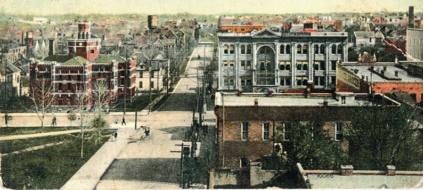
McNeil Street, Shreveport.
Shreveport’s origin of everyday names
Each day as we go about our lives, we drive throughout town on streets that are familiar to us. We may focus more on the address number than the name because they are so familiar. Have you wondered why a street has its name? There’s often an interesting history behind these street names.
Let’s consider Shreveport. The core of downtown Shreveport bears the names of people who were well known when Shreveport was incorporated as a city. Shreveport had become a stopping point and a place to replenish supplies as settlers journeyed westward. It had quickly moved from the small Shreve Town development on the riverbank, founded in 1836, to incorporation in 1871.
There is a short street named Shreve Street just off Sam Fertitta Drive. No, it was not the location of Captain Henry Miller’s home in Shreveport. Ironically, Captain Henry Miller Shreve, partner in the Shreve Town development and the man for whom our city was named, never resided in Shreveport. Another of the original partners of the Shreve Town development is honored with a prominent street.
Angus McNeil gave his name to McNeil Street downtown. That’s appropriate since he was the president of Shreve Town Company and served as the city’s first mayor.
Some streets in the central business district are named after heroes of the 1845 Texas Revolution. William Barret Travis was the commander of the famed Alamo siege in 1836.
Davy Crockett was a frontiersman and politician who moved to Texas and helped defend the Alamo against the Mexican army.
Larkin Edwards was the federal Indian agent responsible for negotiating the U.S. Treaty with the Caddo Nation. As a result of his service in gaining the land, he was allotted some of that land from the acreage he purchased for the government. Caddo Street is named for the native tribe.
Commerce Street was home to many of the riverfront commercial businesses nearest the river — a wide street and railroad track today. While today we see it separated from the river by a railroad track and buildings like Riverview Hall and Sci-Port, the river at the time came much closer to the street where steamboats unloaded their cargo.
Market Street was named for the market located in what is now the middle of that street downtown.
Louisiana Street bears the name of the state, and Texas Street is equally obvious. It led the way out of town to Texas.
While these names seem obvious, some are more obscure.
Drive along Lake Street, and you’ll never see a lake; however, there was one there when the street was named. Lake Street ran near the shore of Silver Lake. That lake was on the land which is now under I-20, where the Ogilvie Hardware apartments are located.
Spring Street had nothing to do with a season; it was named for a natural spring that still exists and flows underground downtown.
Common Street served as a common terminal for the streets that run parallel to Texas Street. It formed the western boundary of the original town on the plateau’s western edge.
Don’t expect to see a wall along Wall Street in the Highland neighborhood. There was once a wall there that had been constructed as part of Shreveport’s Civil War defenses. It’s long gone.
Fairfield Street was named by developer A.C. Steere, who felt it to be the kind of name that would attract wealthy people. He was right!
South of downtown, Common Street becomes Line Avenue. It was given that name because it was the boundary line between two townships. It ran true south until it made a bend south of 70th Street, the southern limit of Shreveport many years ago.
And speaking of 70th Street, it has not always had that name. As cities grow and annex property, duplicate names sometimes arise. When Cedar Grove was annexed in 1927, that town already had a Highland Street among other common street names. The decision was made to rename the east-west streets numerically to avoid confusion. Imagine living on one street and, the next day, living on another without having to move.
Stoner Avenue has no connection to drug culture. It took the name from Stoner Plantation, located at the eastern end of Stoner today.
It was a commercial dairy, ranch and slaughterhouse for cattle, and live cattle were shipped downriver from its own dock, which would have been at the intersection of Stoner Avenue and Clyde Fant Parkway, named for the city’s longest-serving mayor (1948-1970).
Today’s young people certainly know the parkway, but it’s unlikely that they know anything about that mayor. And that’s a sad thing because there is such a rich history in our community. We need to preserve it, and that’s what historians like me are charged with doing.
Dr. Gary Joiner is a Professor of History at LSU Shreveport, where he is the Director of Red River Regional Studies and the Strategy Alternatives Consortium. He can be contacted at Gary.Joiner@lsus.edu.

