Let's All Geaux to the Mardi Gras!

Sashaying in the second line is a Mardi Gras-must during carnival season.
Get down, get funky and laissez bon temps rouler
Shreveport-Bossier may sit at a cultural angle from south Louisiana, but no corner of the state escapes the pull of Mardi Gras.
The season predates America, arriving in the Gulf South from France via medieval Europe before becoming a defining regional tradition. Shreveport’s first recorded Mardi Gras celebration dates back to 1847, marking the beginning of a local carnival that would grow increasingly elaborate.
In its early years, Texas Street served as the heart of the festivities, crowded with parades, horses, mules and thousands of spectators. What set Shreveport apart was its distinctive mix of elaborate floats and costumes alongside the public display of livestock — a reflection of the city’s uniquely local take on Mardi Gras.
By 1927, the economic strain of the Great Depression had largely dampened interest in celebration and spectacle. For decades, Mardi Gras faded from public life. Years later, forgotten film footage discovered in a closet at the State Fairgrounds revealed a vibrant world of parades and pageantry from before what some now call Shreveport’s Mardi Gras “dark ages” — a roughly 60-year period when the tradition largely disappeared. Funds were raised to preserve the footage by first converting fragile nitrate film to VHS and later to digital formats.
Mardi Gras began its modern revival in the 1990s, led by local krewes determined to reignite the celebration and pass it on to future generations. Today, more than 17 krewes operate across Shreveport-Bossier, each bringing its own personality and traditions to the season. They roll out in the weeks leading up to Fat Tuesday, the day before Ash Wednesday and the start of Lent.
Parades and events roll out in the weeks leading up to Fat Tuesday, the day before Ash Wednesday and the start of Lent. This year’s abbreviated schedule is packed, with multiple events often sharing the same weekends — a clear sign that Mardi Gras has once again found its footing in northwest Louisiana.
The Northwest Louisiana lineup includes: Krewe of Sobek
Founded in Shreveport in 2003 by nine community leaders, the Krewe of Sobek is a predominantly African American Mardi Gras organization that brings Carnival traditions to minority neighborhoods. The krewe is known for its charitable work, unique alligator-themed throws, and for opening the Shreveport Mardi Gras season with its parade in the Queensborough area.
Named after the Egyptian crocodile god of order, Sobek’s royal court features Egyptian-inspired elements. Its motto, “Rebirth, Strength, and Tenacity,” is reflected in its signature events: a grand ball and parade that showcase floats and second-line traditions. The XXIII Krewe of Sobek celebrated their Grand Bal on Jan. 16 with a sold-out convention center! The Krewe of Sobek parade rolled out January 17.
Krewe of Harambee
The Krewe of Harambee, Shreveport’s first African American Mardi Gras krewe, was founded in 2000 to increase minority participation in Carnival and celebrate Black culture.
Its name, a Swahili word meaning “pull together,” reflects its mission of community self-help and support for local charities, including scholarships and aid programs.
Harambee’s parade was held on Martin Luther King Jr. Day, January 19.
Krewe of Centaur | Feb. 7 | Downtown
The Krewe of Centaur was founded in Shreveport in 1991 by 38 friends and has since grown into the largest Mardi Gras parade in the Ark-La-Tex. Known for its large floats, abundant throws of beads and cups, and family-friendly atmosphere, Centaur has become a “super krewe” with a mythological centaur-theme inspired by racetrack imagery. The parade also has a significant economic impact on the region through tourism. Centaur’s Float Loading party will be 5 p.m. Friday, Feb. 6, at The Krewe of Centaur Den on 351 Aero Drive in Shreveport.
Centaur’s Grand Bal will be at 5 p.m. Saturday, Jan. 24, at Shreveport Convention Center.
The Parade begins at 3 p.m. Feb. 7 at Clyde Fant and ends on East Kings Hwy.
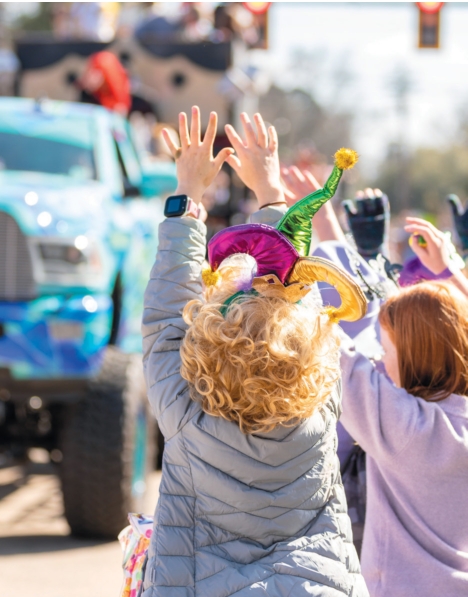
“Throw me something mister” is heard up and down the parade routes of Shreveport.
Krewe of Gemini | Feb. 14 | Downtown
The Krewe of Gemini, founded in 1989 in Shreveport-Bossier City, is the area’s first modern parading Mardi Gras krewe. Created in partnership with the Bossier Chamber of Commerce and Bossier City, the krewe relies on volunteers to bring traditional Mardi Gras pageantry to the Ark-La-Tex.
Gemini’s first parade rolled in 1990 with rented floats and charter members. Since then, it has grown into a beloved annual event featuring elaborate parades, themed balls, and intricate costumes, establishing a decades-long community tradition. Gemini’s Grand Bal will be at 6 p.m. Saturday, Jan. 31, at the Shreveport Convention Center. Their Float Loading Party is 5 p.m. Friday, Feb. 13, at Krewe of Gemini Den on 2101 E. Texas St. in Bossier and the parade begins on Saturday, Feb. 14 at 3:30 p.m., following the same route as Centaur on Clyde Fant to East Kings.
Krewe of Highland | Feb. 15 | Highland Neighborhood
The annual carnival began in 1994 when Highland resident and local business owner Matthew Linn approached the Highland Area Partnership with the idea of a neighborhood Mardi Gras parade. Highland is best known for unique throws like hot dogs and Moon Pies.
Known for its quirky, homemade floats and unique throws, the krewe also emphasizes community involvement, from planting trees to local outreach. Its first parade featured wagons and a party barge, and over the years, the event has grown from a shoestring operation into a much-anticipated daytime celebration.
Krewe of Highland’s Grand Bal is 7 p.m. Friday, Feb. 13, at Capri Theatre. The Parade rolls at 2 p.m. Sunday, February 15.

