Meadows Museum of Art Celebrates 50 Years

Meadows Museum of Art Celebrates 50 Years
Shreveport artist Eric Francis was born in New York and has lived in Chicago – two cities with numerous, critically-acclaimed art museums.
But there was something special about having his work shown at the Meadows Museum of Art at Centenary College of Louisiana.
“It was absolutely amazing,” Francis said. “I used to be a student at Centenary, so it was a dream come true, to tell you the truth. I’ve always loved the museum. It’s one of the better museums around town. To have the opportunity to show there was really, really nice. Really nice.”
This year, the Museum is celebrating its 50th birthday. Through May 8th, you can see exhibits related to the past half-century. February 21st — 50 years to the day the Museum opened – you can take part in a birthday celebration from 10am-3pm.
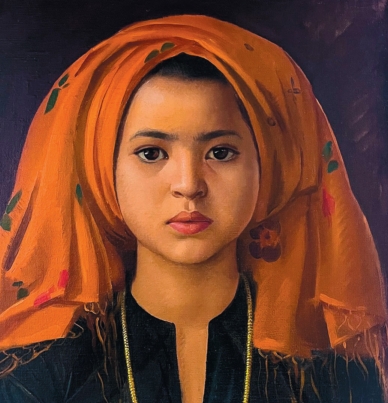
“Tega” by Jean Despujols (1969)
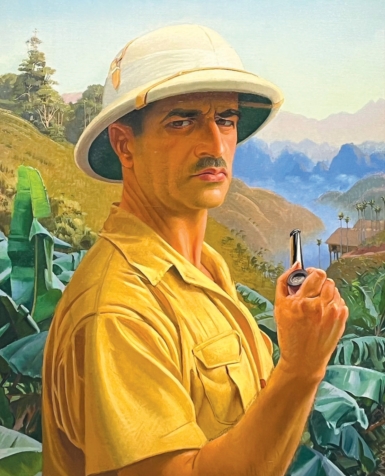
“The Artist on the Trail from Tsinh-Ho” by Jean Despujols (Self Portrait) (1969).
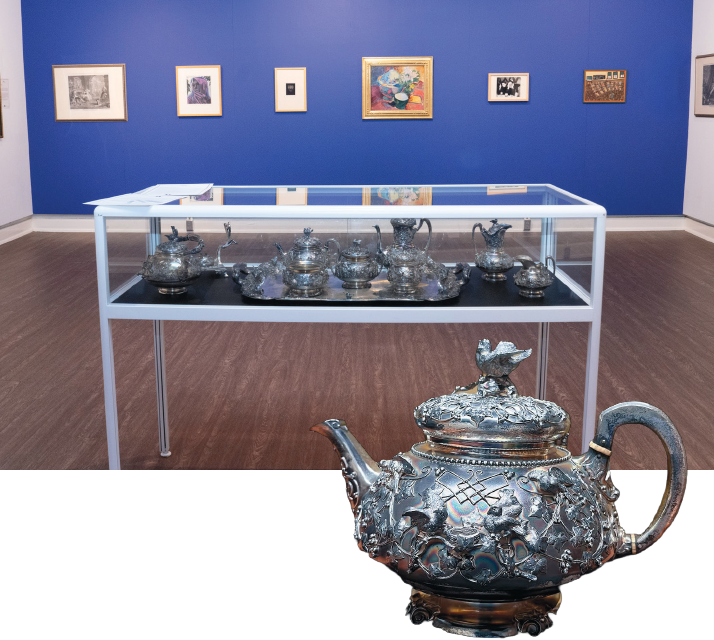
Tiffany & Co. under direction of John Chandler Moore “Tiffany Silver Tea Service” (1999).
Contributing to its prestige is the fact the Museum is accredited by the American Alliance of Museums.
“There are only about 1,000 museums – and it might be less than that – which are accredited in the United States,” said Alissa Klaus, the Museum’s director. “We are the only one in Shreveport, and the only one in northwest Louisiana that is fully accredited.”
That accreditation reflects on not just the Museum, but the entire school.
“The presence of a nationally-accredited museum on campus is a distinctive feature of Centenary,” college president Dr. Christopher Holoman said. “It is an incredibly valuable asset, where our students learn a wide range of skills in the arts, communication, museum management, and more. It also provides a welcoming destination on campus for our community.”
Klaus is a former Centenary student who in 2015 worked in the museum as an intern. She is in her fifth year overseeing the Museum.
“It’s so cool. It’s such a full circle moment. I’ve found little notes that I made as a student and that’s been fun to look back at, and recognize my handwriting in some of the files.”
Admission to the Museum is always complimentary.

“Nativity” by Clementine Hunter (1999) 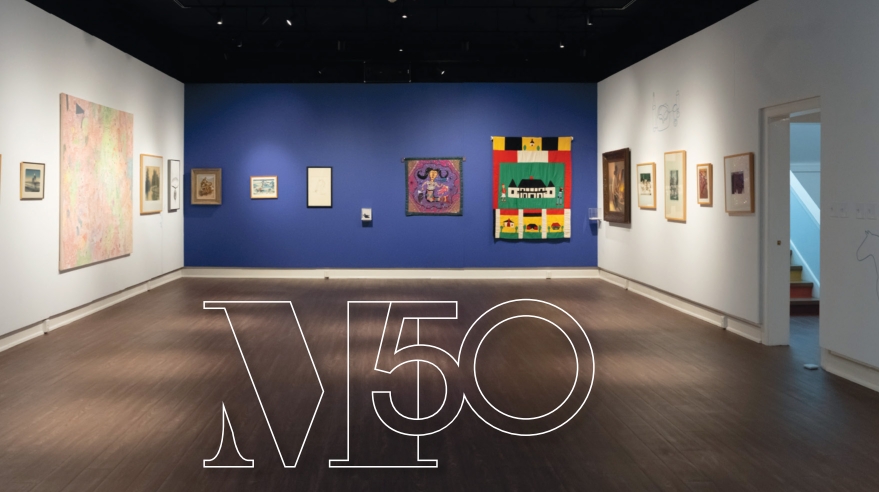
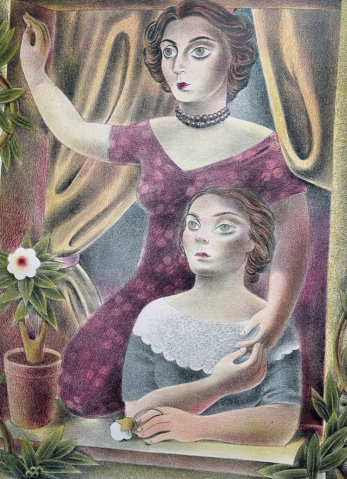
“Las Hijas de Florence Cane (The Daughters of Florence Cane)" by Emilio Amero (1936).
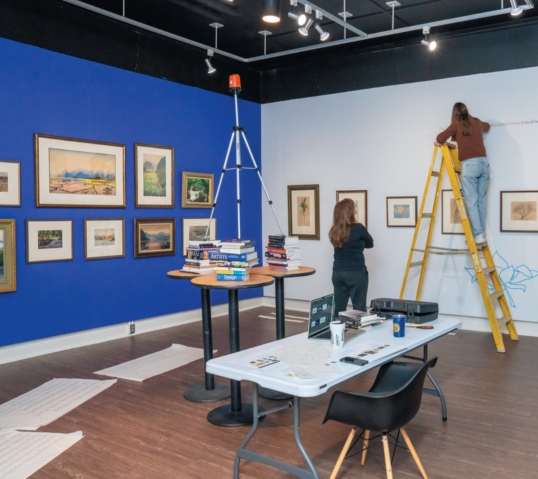
Hanging the 50th Celebration exhibit at Meadows.
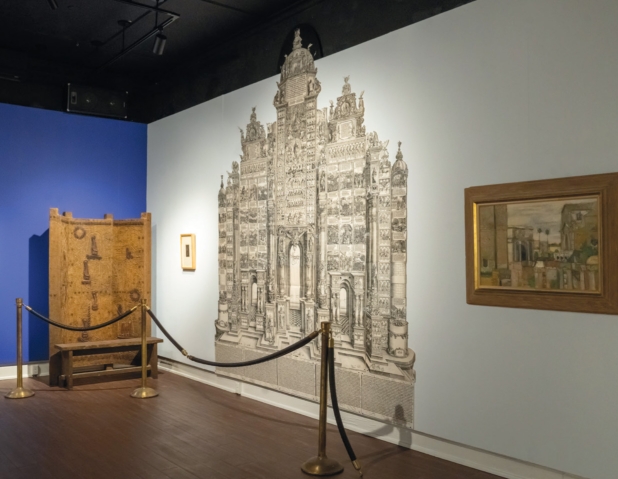
From the current exhibit at the Meadow’s Museum of Art.
“Almost all of our programming is free. We have artist talks regularly throughout the year, and other ways people can interact with the museum. Also, for the public, we have a membership program if they are interested in supporting the museum financially, to help us stay free and support the care of our collection, and the programs we offer to the public and the campus.”
That collection has grown over the years to approximately 1600 pieces, including American, French, Haitian, African, Inuit, and Japanese art.
“I think the versatility gives people something different to look at every time they’re here,” Klaus said. “Since we change our exhibits pretty frequently, we get to show different things that represent different things about the world we live in, and different parts of history. If it was always the same thing, I think people would get tired of it and not want to keep coming back.”
People have kept coming back since 1976. Centenary graduate Algur H. Meadows bought 360 pieces of art that were created by the French academic artist Jean Despujols. Despujols was hired to go to the French colony of Indochina, and paint the people, land, and buildings he came across.
“Mr. Meadows purchased that entire collection and gifted it to Centenary College, along with funds to renovate this building into a museum,” Klaus said. “We have many pieces by Despujols on display this semester to honor that original gift.”
(Algur H. Meadows also gave a collection of Spanish art to Southern Methodist University, and that school has a Meadows Museum).
While the Museum serves a visual purpose, it is also rooted in academics, serving as an educational unit of the school which houses the Museum.
“We do a lot with Centenary students to give them learning opportunities outside of their normal classroom, where interdisciplinary classes come here for different types of lessons,” Klaus said. “We have studio art classes coming frequently, and art history classes coming and studying pieces from our collection or looking at our current exhibition.”
In addition, a psychology class helped curate an exhibit about the psychology of color, and how the eye and the brain interpret color. A math class went to the museum and learned “how we measure where we put nails in the wall to make sure our pieces are equally spaced out down the wall and centered at the right height,” Klaus explained.
For the current exhibit honoring the Museum’s 50th year, 27 faculty members from across Centenary’s campus were invited to choose pieces from the Museum’s permanent collection and interpret those pieces from the perspective of their academic discipline.
“We had someone from physics who chose a piece that has a violin in it, and he explained (in a text panel accompanying the piece) the physics of musical instruments,” Klaus said.
The Museum’s collection has grown over time. In fact, new pieces were added last year. But it’s not like the Museum accepts anything that’s offered.
“We have a permanent collection committee that has to look at any donation requests or purchase requests, and make sure it fits with our collecting guidelines, that we have the space to store it, and the resources to care for it and interpret it for the public,” Klaus said.
And just because the Museum is in a smaller city, that doesn’t mean it can’t compare to what big cities have to offer.
“You would think New York and Chicago would be a bigger deal,” artist Eric Francis said. “But when you look at the quality of the work (the Museum) has, that’s what it’s really all about for artists. A lot of museums in New York and Chicago get more name recognition because they’re in bigger cities, but the quality of work isn’t necessarily that much better, or it’s the same.”
Society – the world – has changed a lot the past 50 years. If you want to look at something, you can do so on your phone from wherever you are. So, the question begs, is there still a place for a museum in 2026?
“If you’re looking at a piece of artwork on your phone, you might be able to see some detail, but you’re not going to know how big the piece is,” Klaus said. “You’re not necessarily going to know how it relates to the rest of the artists’ collection, or how it might relate to other pieces in a room. You might actually miss out on some of the details.”
The current exhibit covers all four of the Museum’s galleries.
“There’s a lot of work that goes into the curation of a show,” Klaus said. “We’re not just picking items. We’re choosing them intentionally. We’re trying to tell a story with our exhibits, and I think we’ve done a really good job with our 50th year exhibit.”
For more information on the Meadows Museum, you may visit themeadowsmuseum.com.

